
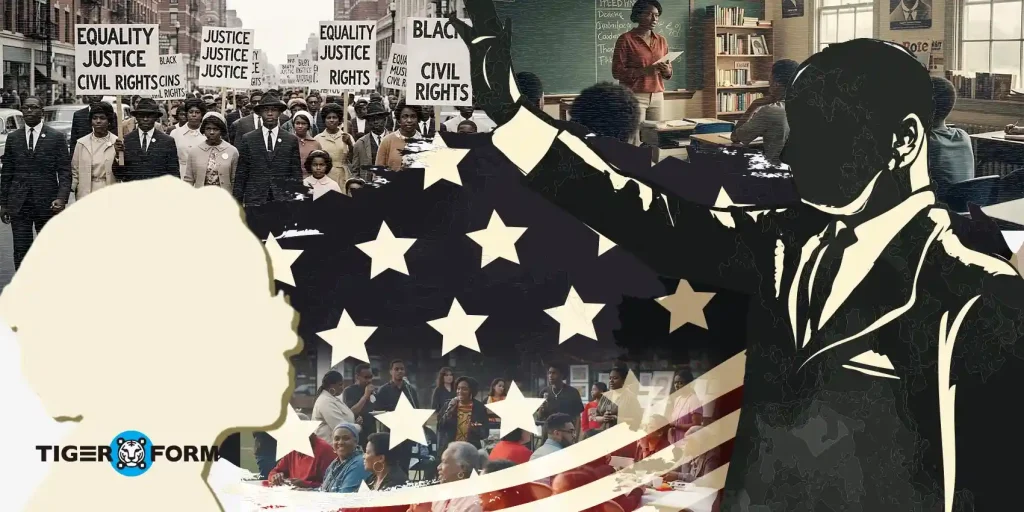
In 1926, historian Carter G. Woodson saw a gap in how history was being told. Black achievements were often absent from textbooks and public recognition. To address this, he created Negro History Week, a step that would eventually grow into Black History Month.
This observance reminds us that progress did not happen on its own. It was built by people who pushed for change, equality, and opportunity.
Today, Black History Month continues that purpose. It invites schools, workplaces, and communities to recognize contributions that were long overlooked and to ensure these stories remain part of the historical narrative.
In this blog, we’ll look at how Black History Month started, meaningful ways to celebrate, a short trivia on leaders who made history, and how to turn the Trivia into an online form using an online form creator.
What is Black History Month, and why is it celebrated in February?
Black History Month is an annual observance dedicated to recognizing the contributions, achievements, and history of Black individuals and communities. In the United States and Canada, it takes place in February. The month was chosen to honor the birthdays of Abraham Lincoln, born on February 12, and Frederick Douglass, celebrated on February 14, both closely associated in the fight against slavery and the advancement of civil rights.
When. Woodson established Negro History Week in 1926 through the Association for the Study of African American Life and History, he chose February to build on those existing traditions. The aim was not only to honor Lincoln and Douglass, but to broaden the focus to include the full scope of Black history and achievement.
A look back at the origins of Black History Month
To understand the importance of Black History Month, let’s look at how the observance has developed over the years. The following milestones trace that progression.
1. 1926: Negro History Week is established
Woodson created the observance to highlight Black achievements that were often excluded from textbooks and public recognition.
2. Organizational support and structure
The Association for the Study of African American Life and History institutionalized research and educational efforts that continue today.
3. February was intentionally chosen
The week was placed in February to align with the birthdays of Abraham Lincoln and Frederick Douglass..
4. Expansion during the Civil Rights era
By the 1960s, during the Civil Rights Movement, colleges and activists began expanding it beyond a single week, reflecting growing public awareness and academic interest in Black studies.
5. 1976: Official recognition as Black History Month
During the United States Bicentennial, the observance officially expanded from a week to a full month. This marked the formal recognition of Black History Month nationwide.
6. International observance
Over time, other countries adopted similar recognitions. It is observed in February in the United States and Canada, and in October in the United Kingdom.
7. Continuing purpose
While the format has evolved, the purpose has remained consistent. Black History Month exists to ensure that Black contributions are recognized as central to history, not separate from it.
Innovative ways to celebrate Black History Month
In Schools
Classroom discussions
Dedicate time to exploring historical events, movements, and individuals that are often underrepresented in textbooks. Use different types of questions, like open-ended questions encourage critical thinking rather than surface-level recall.
Timeline projects
Have students build chronological timelines of major milestones in Black history. This helps connect individual achievements to larger social and political shifts.
Documentary screenings
Organize viewings followed by guided discussions. Provide a discussion sheet so students can analyze themes, context, and impact.
Reading assignments
Assign works by Black authors across subjects, not just history. Pair readings with short reflections or group discussions to deepen understanding.
Interactive quiz sessions
Host a Black History Month quiz in class. Include questions on historical figures, cultural contributions, and key events. You can make it team-based to encourage participation. Keep it educational but engaging, and use it as a starting point for deeper discussion rather than just competition.
In Workplaces
Guest speakers
Invite historians, authors, or community leaders to speak about Black history and contemporary issues. Allow time for thoughtful questions.
Diversity panels
Organize moderated conversations focused on learning and shared insights. Set clear guidelines to ensure respectful dialogue.
Internal education campaigns
Share weekly highlights, short biographies, recommend must-read black readings, or mini-quizzes through internal newsletters or communication platforms. Consistent, small learning moments can have a strong impact.
In Communities
Museum visits
Plan visits to local museums or cultural centers featuring Black history and art. Encourage group reflection afterward.
Volunteer events
Partner with local organizations to support community development and education through service initiatives.
Local history initiatives
Research and spotlight Black history within your own city or neighborhood. Create a community display, digital post series, or walking tour to share those stories more widely.
50 Black History Month trivia questions on historic leaders
- Who founded Negro History Week in 1926?
Answer: Carter G. Woodson - Which abolitionist became a powerful writer and orator after escaping slavery?
Answer: Frederick Douglass - Who was the first Black woman elected to the U.S. Congress?
Answer: Shirley Chisholm - Who delivered the “I Have a Dream” speech in 1963?
Answer: Martin Luther King Jr. - Who refused to give up her seat on a Montgomery bus in 1955?
Answer: Rosa Parks - Which abolitionist led enslaved people to freedom through the Underground Railroad?
Answer: Harriet Tubman - Who was the first Black President of the United States?
Answer: Barack Obama - Which South African leader spent 27 years in prison before becoming president?
Answer: Nelson Mandela - Who became the first Black man appointed to the U.S. Supreme Court?
Answer: Thurgood Marshall - Who was the first Black woman appointed to the U.S. Supreme Court?
Answer: Ketanji Brown Jackson - Which journalist led an anti-lynching campaign in the early 20th century?
Answer: Ida B. Wells - Who founded the Universal Negro Improvement Association?
Answer: Marcus Garvey - Who co-founded the Student Nonviolent Coordinating Committee (SNCC)?
Answer: Ella Baker - Which civil rights leader emphasized grassroots organizing and voting rights?
Answer: Fannie Lou Hamer - Who was the first Black woman in space?
Answer: Mae Jemison - Who wrote The Souls of Black Folk?
Answer: W. E. B. Du Bois - Which educator founded the Tuskegee Institute?
Answer: Booker T. Washington - Which Black leader became the first woman of South Asian and African descent to hold the office of U.S. Vice President?
Answer: Kamala Harris - Which civil rights leader was assassinated in Memphis in 1968?
Answer: Martin Luther King Jr. - Who was the first Black governor elected in the United States?
Answer: Douglas Wilder - Which Nobel Prize–winning author wrote Beloved?
Answer: Toni Morrison - Who was the first Black Secretary of State of the United States?
Answer: Colin Powell - Who became the first Black woman CEO of a Fortune 500 company?
Answer: Ursula Burns - Which activist delivered the “Ain’t I a Woman?” speech?
Answer: Sojourner Truth - Who co-founded the Black Lives Matter movement?
Answer: Alicia Garza - Who was the first Black woman to win an Academy Award for Best Actress?
Answer: Halle Berry - Which leader helped organize the 1963 March on Washington?
Answer: A. Philip Randolph - Who became the first Black U.S. Surgeon General?
Answer: Joycelyn Elders - Which civil rights leader was known for promoting the philosophy of nonviolence?
Answer: Martin Luther King Jr. - Who was the first Black four-star general in the U.S. military?
Answer: Colin Powell - Which South African leader became the first Black president of the country?
Answer: Nelson Mandela - Who founded the National Council of Negro Women?
Answer: Mary McLeod Bethune - Which abolitionist published the newspaper The North Star?
Answer: Frederick Douglass - Who was the first Black woman elected mayor of a major U.S. city (Washington, D.C.)?
Answer: Sharon Pratt - Which activist was a key figure in the Freedom Rides?
Answer: Diane Nash - Who was the first Black woman elected to the U.S. Senate?
Answer: Carol Moseley Braun - Which legal scholar argued Brown v. Board of Education before the Supreme Court?
Answer: Thurgood Marshall - Who became the first Black Secretary of Defense?
Answer: Lloyd Austin - Which activist was a leading voice of the Black Power movement?
Answer: Stokely Carmichael - Who founded the NAACP in 1909 alongside other reformers?
Answer: NAACP - Who was the first Black billionaire in the United States?
Answer: Robert F. Smith - Which educator and advisor worked closely with President Franklin D. Roosevelt?
Answer: Mary McLeod Bethune - Who was the first Black chairman of the Joint Chiefs of Staff?
Answer: Colin Powell - Which abolitionist also served as a Union spy during the Civil War?
Answer: Harriet Tubman - Who was the first Black woman to run for U.S. president from a major political party?
Answer: Shirley Chisholm - Which civil rights organizer helped lead the Birmingham Campaign?
Answer: Fred Shuttlesworth - Who was the first Black woman to serve as U.S. Secretary of State?
Answer: Condoleezza Rice - Which leader advocated vocational education and economic self-reliance in the late 19th century?
Answer: Booker T. Washington - Who co-founded the Southern Christian Leadership Conference (SCLC)?
Answer: Martin Luther King Jr. - Which civil rights leader was known for organizing the Selma voting rights campaign?
Answer: John Lewis
Create these online trivia in a form using an online form creator
Creating online trivia has never been easier or more engaging. Digital quizzes let participants join instantly from anywhere, automatically track responses, and provide instant feedback, making them perfect for classrooms, workplaces, or community events.
Using a modern form creator online like TIGER FORM, you can turn your Black History Month quiz into a professional, interactive experience in just a few simple steps.
Step 1: Choose a quiz template
Start with a ready-made form template inside TIGER FORM. Most form builders like TIGER FORM offer quiz or survey templates that already include multiple-choice and short-answer fields. You simply replace the placeholder questions with your Black History Month quiz.
Step 2: Use AI form creation
Many modern form builders, including TIGER FORM, offer AI-powered form creation that lets you generate a complete quiz in seconds. Simply paste your questions or enter a prompt like, “Create a 25-question multiple-choice quiz on influential Black leaders,” and the tool automatically formats, structures, and organizes it for you.
Step 3: Add your questions
Input your quiz questions one by one or paste them in bulk.
Choose the appropriate field types:
– Multiple choice for leader identification
– Short answer for name-based questions
– Checkbox if multiple answers are possible
Step 4: Customize the design
Brand the form design to match your school, workplace, or organization.
You can:
– Add a title and short introduction
– Include images of historical leaders
– Adjust theme colors
– Add a progress bar for longer quizzes
Step 5: Enable auto-scoring and results
If you’re using it competitively or educationally, set correct answers within the form settings.
This allows:
– Instant score calculation
– Automatic feedback
– Leaderboard-style engagement
– Participants get immediate results, which keeps it interactive and motivating.
Step 6: Share the quiz
Once published, you can do the form sharing with the QR code.

Keeping the stories, struggles, and triumphs alive
History shapes how societies remember progress and injustice. Black History Month exists to ensure contributions and struggles are not forgotten or treated as separate chapters.
Sharing these stories widely helps others understand the depth and breadth of Black contributions across education, politics, science, art, and social justice.
When these stories are shared beyond February, Black history becomes part of the ongoing story we all learn from and build upon.
FAQs
1. What happened on February 1st in Black history?
February 1 marks the start of the 1960 Greensboro sit-ins and is also recognized as National Freedom Day, commemorating the signing of the 13th Amendment, which ended slavery.
2. Who founded Black History Month?
Black History Month was founded by historian Carter G. Woodson, who originally created Negro History Week in 1926.
3. Who are the top 5 Black activists?
Some of the most influential Black activists include Martin Luther King Jr., Rosa Parks, Frederick Douglass, Malcolm X, and Harriet Tubman.